Showing posts sorted by relevance for query peters. Sort by date Show all posts

Friday, March 29, 2013

Peters' dinosaur phylogeny fails finale part 2 - The test

The last post covered many of the problems with Peters' amniote analysis- codings based on sculpted or nonexistent material, codings based on reconstructions, an unfamiliarity with the literature, coding small and easily lost elements as truly absent, using too few characters which mostly involve general proportions and shapes, mis-applying characters, making new states so that homology is hidden, using interphalangeal lines for characters, and basically having a third of all scores miscoded.  This in addition to issues I've covered before like not ordering character states, having correlated characters, having poorly formed characters that combine different kinds of changes, and leaving out characters that support certain clades.  But as I said before, Peters doesn't find these kinds of critiques to be especially harmful to his conclusions.  Requoting him-

He says "You missed the point, Mickey. What I am asking you to do is adjust my tree topology to suit your hypothesis. Then we can compare your changes to the large reptile tree. I’ll put up your figures and compare them with mine. Then we’ll look at synapomorphies. The list of characters is infinite for any taxon, as you can get down to individual chemistry and DNA if you like. So, merely listing a few to a dozen characters is not a solution. Rearrange the tree topology like you want to, then we’ll talk."  And "You have your assignment: Nest Daemonosaurus with theropods while including Heterodontosaurus and Massospondylus. That’s a half-dozen to a dozen taxa at most to deal with. Then we’ll compare answers."

So that's what we're doing today.  Taking the dinosaur portion of his tree, adjusting the codings to be correct and the character states to be well-formed, less correlated, ordered when appropriate, and seeing the results.  Then looking at what synapomorphies support clades in Peters' tree.

For those of you who don't want to wade through the minutia below, here's the short answer.  Peters'dinosaurian topology is completely due to miscodings and lack of characters/taxa.  When coded right, poposaurs fall outside Dinosauria, and Trialestes and SMNS go next to Terrestrisuchus once it's added, but we get new odd things like poposaurian Daemonosaurus, and theropodan Pseudolagosuchus, Silesaurus and Saturnalia.  As we add taxa one at a time, the phylogeny changes constantly so that sauropodomorphs are variously paraphyletic to theropods and/or ornithischians in different configurations, Saurischia is para- or monophyletic, silesaurs are polyphyletic in different ways, etc..  Simply put, there aren't enough characters to to stabilize topology, and it's only stable in Peters' matrix because he miscodes a ton.  If we add the saurischian and dinosaurian characters I noted long ago on this blog, the topology is fairly standard, and if we add the character evidence for Daemonosaurus being a theropod, it becomes a theropod.  I have no reason to believe the rest of his matrix isn't miscoded to a similar extent in similar ways, and that even if it were corrected, would lack the characters and taxa needed to be useful.

Methods

This evaluation uses Peters' amniote matrix from January 22, 2013.  He has since updated it (I assume in part due to my comments on his site about miscodings in some of his 'theropod' OTUs), but the only difference is that Trialestes is now sister to Dinosauria instead of the most basal theropod.  His matrix includes 228 characters, and this evaluation uses all of the taxa Peters recovers as avemetatarsalians (closer to birds than crocs).  For outgroups, I chose Gracilisuchus and Turfanosuchus.  Gracilisuchus is one of the most basal pseudosuchians (closer to crocs than birds) in Peters' tree, while Turfanosuchus is sister to Pseudosuchia+Avemetatarsalia.  Both are also well described and known from articulated skulls.  Note this is favoring Peters, as better outgroups in traditional phylogenies like Nesbitt's (2011) would be lagerpetids, pterosaurs and ornithosuchids.  But Peters finds those taxa to be more distantly related, so they are ignored here.  Similarly, Peters recovers Saltopus and Scleromochlus as pseudosuchians, so they are ignored.  Another important point is that he finds Lewisuchus to be outside Archosauria, so it is ignored here though traditionally it is considered close to and probably synonymous with the included taxon Pseudolagosuchus.  If we run this reduced analysis of Avemetatarsalia plus two outgroups, we get the same result as running the entire analysis of 328 taxa, so we know any changes in topology aren't due to only analyzing this area of the tree.

Running Peters' data results in one MPT of 354 steps.  90 characters don't vary in included taxa, and 18 variable characters can't affect the topology, so the number of useful characters is 120.  It has a consistency index of .52, so on average each character reverses or converges once.

So let's start fixing it.  Besides the Pseudolagosuchus note above, a few clarifications are necessary.
- For Turfanosuchus, only the type species was coded.  The more fragmentary T. shageduensis is no longer thought to be congeneric.  I lack the original description of Turfanosuchus, so this is the single instance where my codings do not reflect the total published knowledge of a taxon, but Peters lacks it too, so this shouldn't matter for our test.  Nesbitt says it's not great anyway, and as it's in Chinese only the figures would be useful to me if I had it.
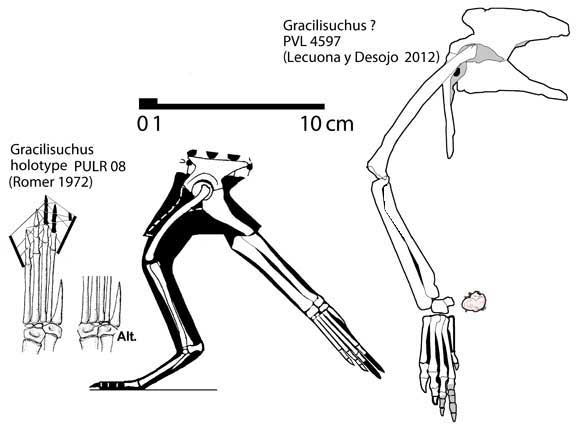
- For Gracilisuchus, I included all specimens generally attributed to it (the holotype PULR 08, MCZ 4116, MCZ 4117, MCZ 4118, PVL 4597 which is the Tucumen specimen, and PVL 4612).  Romer (1972) used all of these when describing and illustrating the taxon, Brinkman (1981) reinterpreted the skull based on MCZ 4116 and 4118, and Lecuona and Desojo (2012) described the pelvis and hindlimb of PVL 4597 in depth.  Peters did not realize Romer used these latter three specimens too, and coded PVL 4597's pelvis and hindlimb and most recently MCZ 4116+4118's skulls and cervicals as separate OTUs from Romer's composite description/drawings. 
- For Trialestes, I only included the holotype, as Ezcurra et al. (2008) found the referred specimens to be a mix of dinosaur and indeterminate suchian bones (PVL 2559) and an indeterminate crocodylomorph (PVL 3889).  This is important because Peters' codings are almost entirely the crocodylomorph holotype skull and the dinosaurian and possibly herrerasaurid pes of PVL 2559.  So it's not surprising it falls out between crocodylomorphs and dinosaurs in his tree, since it's a composite.
- SMNS 12352 includes both a skull and a manus (these are the specimens originally referred to Procompsognathus that Sereno and Wild referred to Saltoposuchus in 1992), though Peters ignores the latter.
- Coelophysis is only coded based on C. bauri, which I think is what Peters did too.
- Massospondylus k is M. kaalae, shortened due to PAUP's display.  This species is based on a partial skull.
- On Peters' Thecodontosaurus page, he illustrates both the type species T. antiquus and what was originally named T. caducus, which is now known as Pantydraco caducus.  T. antiquus is based on a large number of generally disarticulated and unassociated bones, with a dentary as the holotype.  Most recently, Galton (2007) redescribed them and found them to belong to at least three different taxa based on humeral morphologies.  He named Asylosaurus based on the one articulated partial skeleton there, retained Thecodontosaurus for the dentaries and one kind of humerus, and kept most of the material unassigned.  The codings for Thecodontosaurus in Yates' matrices are apparently based mostly on a bonebed that remains undescribed, though he and Benton are working on it.  Given this mess, I've coded "Thecodontosaurus" based solely on Pantydraco and refer to it with the latter name.  It includes the only described skull and pes, and Peters' clearly used it when coding his OTU.  Later I add the chimaerical "Thecodontosaurus antiquus" as a separate OTU as a test.
- I included Stormbergia in the Lesothosaurus OTU, as I agree with Knoll et al. (2009) that their differences are ontogenetic.

Many of Peters' characters are composites, in that they code for multiple variables.  "Serrations large and tooth roots constricted" as a state, for example.  These had to be split into multiple characters to remain valid, which led to ten "new" characters being made.  This brings the total number to 238.  It would need to be much higher if the inappropriate states describing the anatomy of non-dinosaurs were examined as well.
Characters that have states which follow an objective sequence (e.g. "2 sacrals" "4 sacrals" "3 sacrals", or "humerus longer than femur" "humerus subequal to femur" "humerus shorter than femur") were set to be ordered in PAUP.  Thus, the program knows that e.g. a short humerus is more similar to a subequal humerus than it is to a long humerus.  It's implicit in many of Peters' states such as "more than 4 premaxillary teeth", since under unordered assumptions, 5 teeth is just as similar to 2 teeth as it to 6 teeth.  Ordering characters sometimes meant I had to rearrange the states, so state 2 in my matrix will not always be the same as state 2 in Peters' matrix.
Many of Peters' characters are correlated with each other.  Often this is due to one character coding for the presence/absence of a feature, then another character coding for attributes of that feature and also including a state coding for its presence/absence.  This weights the presence/absence compared to other characters, and is easily solved by making taxa without the feature coded inapplicable for characters about that feature.  Unfortunately, several correlated characters were retained, as altering them would lead to effectively using different characters than Peters, so it would be less fair of a test.  For example, there's a character comparing each cranial fenestra size to orbit size.  So if two taxa are exactly the same except one has larger orbits, they could be coded differently for "orbit compared to naris", "orbit compared to aof", "orbit compared to stf", "orbit compared to itf", and probably "orbit enters anterior half of skull" too.  Similarly, there are several characters coding for the length of metatarsal V, separate characters for which digit is longest and which digit+metapodial is longest, and other such things.  By not changing these, I'm giving Peters another advantage.

Results-

When those changes are made, we get one MPT of 458 steps.  95 characters don't vary in included taxa, and 31 variable characters can't affect the topology, so the number of useful characters is 122.  It has a consistency index of .39, so has more homoplasy than Peters' codings.  Differences include Daemonosaurus being a poposaur, poposaurs being outside Dinosauria, Silesaurus, Pseudolagosuchus and Saturnalia being theropods, Pantydraco being by Panphagia and Pampadromaeus, and Pisanosaurus being an ornithischian.  But like Peters' original tree, Marasuchus, Trialestes and SMNS 12352 are still theropods, and Phytodinosauria still exists with some sauropodomorphs basal in it.


Let's try substituting the probably chimaerical Thecodontosaurus (including Thecodontosaurus, Asylosaurus at at least one other sauropodomorph as well) for Pantydraco.  We get 95 MPTs of 453 steps.  Thecodontosaurus clades with Massospondylus (due to massopod elements?), Herrerasaurus with Saturnalia, and there's much less resolution overall. 

Adding taxa

As Thecodontosaurus is problematic, let's switch back to Pantydraco for the rest of the tests.  Since Trialestes and SMNS 12352 are generally thought to be basal crocodylomorphs, let's add well known crocodylomorph Terrestrisuchus.  It's thought by some to be a juvenile Saltoposuchus (which is poorly described), which is in turn thought by Sereno and Wild to be what SMNS 12352 belongs to.  That gives us 180 MPTs of 490 steps.

Well, that changed things considerably.  Trialestes and SMNS 12352 are now outside Dinosauria, Poposaurus and Silesaurus are successive sisters to Dinosauria, the Pan+Pan+Pam clade is within Theropoda, and lots of resolution has been lost.  Let's add Arizonasaurus as a basal poposaur.

And now Poposaurus and Daemonosaurus are back to Poposauridae, and all the crocodylomorphs are near the base.  What if we add the basal silesaurid Asilisaurus, since Pseudolagosuchus and Silesaurus are still separated.
Far less resolution (seemingly due to Daemonosaurus falling out in multiple possible positions), though Asilisaurus falls out with Pseudolagosuchus and Marasuchus.  So let's try adding another silesaurid- Sacisaurus.
Now Daemonosaurus moves to Theropoda, though most structure in non-theropod Dinosauria is lacking.  So let's try adding a complete sauropodomorph, since the four Peters uses are only partially known.  We add Plateosaurus to find...
Daemonosaurus goes back to Poposauridae, and we get sauropodomorphs (and Sacisaurus) as a grade leading to Ornithischia.  Why not add Massospondylus carinatus, to see if that affects M. kaalae's placement near/in Ornithischia.
Indeed, the Massospondylus species group together, and are sister to Plateosaurus.  But the clade's still closer to ornithischians, so let's try to add an intermediate sauropodomorph.  Efraasia usually lies between Plateosauria and Pantydraco in Yates' trees.
Well, it grouped with Pantydraco.  How about we add Guaibasaurus, as a largely complete (except for the head and neck) basal sauropodomorph.
That helped resolution quite a bit.  Silesaurus is back to being a theropod, so at least is closer to other silesaurids.  We still have sauropodomorphs forming a pre-ornithischian grade, except Saturnalia which is a basal theropod.  How about adding Eoraptor, variously claimed to be a theropod, sauropodomorph, or basal to both.  The result had a polytomy at the base of Poposauridae+Dinosauria, due to Daemonosaurus being able to go in several positions.  When we exclude it from the tree (but not the analysis), we get-
The blue area shows where Daemonosaurus can go.  Note Eoraptor is resolved as the basalmost theropod.  Maybe adding Eodromaeus will help things, since it's another basal theropod.
Here another polytomy results, mostly due to Trialestes (which can go in the blue spaces above) and Pisanosaurus (which can go in the pink spaces).  Daemonosaurus is restricted again to outside Dinosauria, but note things have changed in that basal sauropodomorphs are a grade leading to theropods again, while Silesaurus and Sacisaurus are now just outside Dinosauria.  Saturnalia's still odd being so deep within Theropoda, so let's add the fragmentary saturnaliine Chromogisaurus.
Oddly, this stabilizes the whole tree and changes the topology so that Saurischia and Sauropodomorpha exist.  Panphagia is now sister to Dinosauria, while Sacisaurus is a basal ornithischian.  Both Saturnalia and Chromogisaurus are theropods though.  What about adding the other named herrerasaurids, Staurikosaurus and Sanjuansaurus, to see if that affects Herrerasaurus' position.
This brings things back to generally how they were before Chromogisaurus was added.  Let's add three more basal ornithischians- Emausaurus to potentially connect Scutellosaurus and Scelidosaurus, Tianyulong as a basal heterodontosaurid, and Eocursor.
This is the tree with Chromogisaurus deleted a posteriori, with the pink area showing where it can go.  Here Trialestes is a theropod, though the other crocodylomorphs group together, and Poposaurus is with other poposaurs again.  Most of the tree matches the last one, but note Ornithischia is completely rearranged compared to previous trees with the addition of these three taxa.  Scelidosaurus is still most basal, and Agilisaurus is with Hexinlusaurus, but besides that things are different.  As a final test for Peters' characters, let's add a few fragmentary but potentially important taxa to see if they affect topology- silesaurids Eucoelophysis and Diodorus, and controversial saurischian Chindesaurus. 
With all taxa added, there are 54703 MPTs of length 636 (up from 458) with 139 informative characters (up from 122).  Trialestes is back down by crocodylomorphs, but there's a big polytomy in Dinosauria.  Deleting Eucoelophysis, Diodorus, Chindesaurus and Chromogisaurus a posteriori from the MPTs gives us a more resolved tree.
Notable here is that Saurischia occurs again, with the exception of Efraasia being by ornithischians and Panphagia being sister to dinosaurs.  Also, ornithischian topology is rearranged again, this time with all thyreophorans the basal grade. 

Adding characters

Before we finish this, recall one of my posts criticized Peters analysis for leaving out 16 unambiguous synapomorphies of Saurischia and 11 such synapomorphies of Dinosauria (from Nesbitt, 2011).  We've already seen that depending on the taxa you include, Peters' characters already can support a Saurischia containing all to most sauropodomorphs, but let's see what happens when we add those 16 saurischian synapomorphies.  For those curious, I checked Nesbitt's accuracy too and found only 8% of the entries were miscoded, which is a fourth of Peters' total.
Again, Eucoelophysis, Diodorus, Chindesaurus and Chromogisaurus were deleted a posteriori from the MPTs to give better resolution.  Note the saurischian characters got Panphagia and Efraasia back in the clade, and even made Sauropodomorpha monophyletic (potentially, as Saturnalia is still in a polytomy).  Crocodylomorphs are monophyletic too, though Daemonosaurus is still very basally placed.  There were also the 11 unambiguous dinosaurian characters of Nesbitt I commented on.  Adding those leads to-
Only Eucoelophysis and Daemonosaurus had to be deleted a posteriori from trees to give good resolution here.  Eucoelophysis can go anywhere in the pink area, which covers silesaurids so makes sense.  Daemonosaurus can go anywhere in the blue area, which includes Peters' preferred position (basal ornithischian), the position of its describers (basal theropod), and the position Peters' characters seem to be suggesting (basal near poposaurs).  Since Daemonosaurus is a sticking point with Peters (recall his assignment was "Nest Daemonosaurus with theropods while including Heterodontosaurus and Massospondylus"), let's test Sues et al.'s hypothesis.  We'll add all of the characters (18 total) Daemonosaurus was scored for in their analysis that are also synapomorphies of nodes which include it (namely Avemetatarsalia/Dinosauriformes, Silesauridae+Dinosauria, Saurischia, Theropoda, and two theropod subclades).  These are all cranial and cervical of course, as those are the only areas preserved in the genus.  Other taxa were scored when possible, with codings corrected when necessary, and we get the following tree (when Diodorus is excluded a posteriori).
So there you go, Daemonosaurus is a theropod, and everything else is generally traditional too.  Trialestes and SMNS 12352 are down by Terrestrisuchus, poposaurs aren't dinosaurian, Marasuchus and silesaurids form sister taxa to Dinosauria (except for possibly Sacisaurus), Saurischia exists.  There are some oddities, like Pampadromaeus and Saturnalia being theropods, silesaurids not being monophyletic, and ornithischian phylogeny being wrong, but just like the Daemonosaurus situation, these would probably be solved by adding the suggested sauropodomorph, silesaurid, genasaur, thyreophoran, cerapod, etc. characters to the mix (they only take 3, 6 and 3 more steps each respectively, so are only slightly-weakly rejected).  Just as I've told Peters innumerable times, (when coded correctly) phylogeny does not stabilize at a couple hundred characters.  Look at how much the last 18, 11 and 16 characters affected the entire topology each time, despite only being designed for one purpose each.

Comparing support for clades

Assignment completed, David.  Let's compare answers.  We'll compare the number of extra steps needed to find various groups in Peters' unaltered matrix, Peters' characters fixed and corrected by me using only the taxa he did, the fixed/corrected characters plus the 45 I added with all taxa added, and in Nesbitt's (2011; reduced to have only the taxa examined here that are shared) matrix.  Note all of the constraint trees only involve taxa Peters' included, so e.g. the Dinosauria constraint doesn't force Sacisaurus out of the clade, though it does force Silesaurus out.

First, we'll enforce Avemetatarsalia/Dinosauromorpha, to the exclusion of traditional pseudosuchians.
Peters original- 30
Peters fixed- 2
Peters with new added- 0
Nesbitt- 0
Result- Peters didn't recover this clade based almost entirely on miscodings.

Next, enforcing Silesauridae+Dinosauria.
Peters original- 41
Peters fixed- 10
Peters with new added- 4
Nesbitt- 0
Result- Peters didn't recover this clade mostly due to miscodings, but also due to lacking certain characters and taxa. 

Next, Dinosauria itself.
Peters original- 30
Peters fixed- 8
Peters with new added- 0
Nesbitt- 0
Result- Peters not finding traditional Dinosauria is due mostly to miscodings, but partially due to missing character and taxon data.

Peters' Phytodinosauria including Daemonosaurus, silesaurids and poposaurs.
Peters original- 0
Peters fixed- 12
Peters with new added- 34
Nesbitt- 76 (not Daemonosaurus)
Result- Peters' support is entirely due to miscodings, as fixing these makes the clade rather improbable.  Adding characters and taxa makes this is extremely unlikely to be a real clade.  And lest Peters claims for the nth time it's our emphasis on the crurotarsal ankle that blinds us to placing poposaurs in Dinosauria, even when proximal tarsal characters are excluded, this still takes 59 more steps in Nesbitt's analysis. 

Saurischia.
Peters original-34
Peters fixed- 15
Peters with new added- 0
Nesbitt- 0
Result- Peters doesn't recover this due to half miscoding and half lack of included data.

Peters' Theropoda with Marasuchus and SMNS 12352.
Peters original- 0
Peters fixed- 2
Peters with new added- 19
Nesbitt- 34 (only Marasuchus)
Result- Peters recovered these as theropods due to miscodings, though adding taxa and characters makes them highly unlikely to be correct.

Peters' derived phytodinosaurs excluding Panphagia and Pampadromaeus.
Peters original- 0
Peters fixed- 16
Peters with new added- 35
*Cabreira et al.- 31
Cabreira et al.'s (2011) sauropodomorph analysis was used, as Nesbitt did not include Panphagia or Pampadromaeus.  All taxa were retained, as none are outside the scope of this analysis except the outgroup Euparkeria.
Result- Peters recovered this completely due to miscoding.  At 31-35 steps once other taxa and characters are added, it's highly unlikely to be correct.

'Paraornithischia' consisting of silesaurs, poposaurs and Pisanosaurus.
Peters original- 0
Peters fixed- 13
Peters with new added- 26
Nesbitt- 50
Result-  Again recovered entirely due to miscodings, this becomes rather unlikely once recoded and extremely unlikely with added taxa and characters.

Daemonosaurus sister to Ornithischia sensu lato (Pisanosaurus ignored).
Peters original- 0
Peters fixed- 9
Peters with new added- 10
*Sues et al.- 7
Sues et al.'s (2011) analysis was used, as Nesbitt's does not include Daemonosaurus.  Taxa outside the scope of this critique were deleted.
Result- Another grouping based entirely on miscodings, though in this case added taxa and characters don't affect its liklihood much.  It's always moderately rejected.

Daemonosaurus in derived Theropoda (by Tawa and Coelophysis).
Peters original-18
Peters fixed- 5
Peters with new added- 0
*Sues et al.- 0
Result- Peters' analysis rejected this mostly due to miscodings, but once correct it's only weakly rejected.  Adding taxa and characters makes it most parsimonious.

Sauropodomorpha+Ornithischia.
Peters original-14
Peters fixed- 2
Peters with new added- 8
Nesbitt- 13
Result- While Peters does not actually recover a traditional Phytodinosauria due to having Pisanosaurus, Pampadromaeus and Panphagia in the clade only if silesaurids and poposaurs are, the reduced version seems quite possible once his codings are fixed.  Yet once more taxa and characters are added it becomes unlikely.  In case you're wondering, making silesaurids phytodinosaurs is 28 steps less likely in both Nesbitt's matrix and the version of Peters with taxa and characters added.

Derived Sauropodomorpha+Ornithischia (Pisanosaurus ignored).
Peters original- 0
Peters fixed- 5
Peters with new added- 11
*Cabreira et al.- 25
Result- Peters has Saturnalia, Pantydraco/Thecodontosaurus and Massospondylus kaalae closer to ornithischians than Panphagia and Pampadromaeus.  This is due to miscodings, though it still seems possible once these are corrected.  More taxa and saurischian characters help make this unlikely, but what really kills it are the sauropodomorph charcters and intermediate taxa present in a large analysis like Cabreira et al.'s.

Sauropodomorpha.
Peters original-13
Peters fixed- 12
Peters with new added- 3
Nesbitt- 0
Result- Somewhat uniquely, Peters' characters and taxa really do reject Sauropodomorpha sensu lato (containing Panphagia and Pampadromaeus), even after correction.  Though in the corrected version this is due to Saturnalia and Pampadromaeus being theropods, and Panphagia being outside Eusaurischia in the corrected version.  Adding more taxa and characters makes Sauropodomorpha sensu lato only slightly unlikely, though Nesbitt's character selection makes it most parsimonious.   Though Peters' alternative to monophyly was rejected soundly above (25 more steps in Cabreira et al.'s matrix), you might wonder about "my" alternative.  This is also soundly rejected in Cabreira et al.'s matrix, taking 24 more steps.

Peters' arrangement of Ornithischia (Pis(Scel((Het+Hex)(Agi(Scut+Les))))).
Peters original- 0
Peters fixed- 8
Peters with new added- 14
*Butler- 12
The updated version of Butler et al.'s (2007) ornithischian analysis (from Coria et al., 2013) was used.  All taxa were retained, as none are outside the scope of this analysis except the outgroup Euparkeria.
Result- Peters' odd ornithischian topology with Scelidosaurus basal is due to miscodings.   Adding more data only increases its unliklihood, to a level similar to that in the most exhaustive published ornithischian analysis.

Butler's arrangement of Ornithischia (Pis(Het(Les(Agi+Hex)(Scut+Scel)))))
Peters original-18
Peters fixed- 9
Peters with new added- 3
*Butler- 0
Result-The current standard topology of Ornithischia is strongly rejected by Peters' original matrix, but still somewhat rejected after coding it correctly.  Adding more taxa makes it only weakly rejected, and adding the many ornithischians and applicable characters from Butler's analysis supports it.

Character support

Peters requested we look at synapomorphies, so let's check what characters support heterodox nodes in his unaltered analysis. Of course based on the above, we know these nodes are due almost entirely to miscodings, but just to make sure the thrashing is total and unambiguous, we'll go in for a closer look...

To be continued...

Friday, April 19, 2013

Are Daemonosaurus, silesaurids and poposaurs phytodinosaurs? plus conclusion on Peters

No, of course not.  Phytodinosauria doesn't even exist.   But Peters doesn't believe that, due to the many issues discovered in my evaluation of his analysis.  Last time we looked at the characters he uses to support his heterodox Theropoda.  This time we'll look at the characters he uses to support his heterodox Phytodinosauria and internal clades.  A spoiler for those who don't want to read further- none of Peters' clades are even plausible except for ornithischian Daemonosaurus, which is rejected by "only" 7-10 more steps compared to 25-76 more steps for his other clades.

Phytodinosauria (Panphagia, Pampadromaeus, Sauropodomorpha, Daemonosaurus, Ornithischia, Silesauridae, Poposauridae)
8. Posterior maxilla not flared laterally to form constricted snout.  This was coded by Peters for way too many taxa, and actually has a very mixed distribution.  Effigia, Coelophysis (miscoded), Pantydraco and Heterodontosaurus (not coded) lack it, while Lotosaurus (miscoded), Herrerasaurus, possibly Pisanosaurus (not coded) and Lesothosaurus (miscoded) have it.  Daemonosaurus cannot be coded, contra Peters.
22. External naris faces dorsolaterally instead of laterally.  Peters again codes this for many more taxa than can be evaluated, and miscodes Heterodontosaurus and Silesaurus as dorsolateral when they are actually lateral.  In Peters' topology it's still recovered as supporting this clade, but barely.  Daemonosaurus cannot be coded, contra Peters.
45. Frontal without posterior process.  This was an example in my list of characters misunderstood by Peters.  No included taxon has such a process.
69. Squamosal and quadratojugal form a semicircular indentation in the infratemporal fenestra.  Peters codes this as present in Pampadromaeus (actually lacks it), Lotosaurus, Silesaurus (actually unknown) and Shuvosaurus (lacks it).  That already disqualifies it, but I'll also note that the not included Plateosaurus and Massospondylus carinatus can have a semicircular or pointed indentation, so it's quite a variable character.  Again Daemonosaurus cannot be coded, contra Peters.
119. Dentary decurved.  This is miscoded in Panphagia, Massospondylus kaalae and Daemonosaurus, and not coded in Saturnalia (actually absent).  So only Pampadromaeus and Pantydraco are correctly coded as having it, and I have no issue with this being a synapomorphy within Sauropodomorpha.
125. Posterior mandible deepest anteriorly.  This was miscoded as present in Pampadromaeus, Panphagia, Shuvosaurus (actually unknown) and Effigia.  So it would actually diagnose the sauropodomorph+ornithischian node in Peters tree, though its absence in the non-included Efraasia makes its convergent development in each group likely.  Again, this is miscoded in Daemonosaurus.
Results-  Of six characters, Daemonosaurus has one (which is found in all examined taxa) and lacks two.  Only the external naris being angled more dorsally even potentially supports the clade.

(Sauropodomorpha, Daemonosaurus, Ornithischia, Silesauridae, Poposauridae)
6. Premaxilla a third or more of preorbital length.  This is miscoded in Pantydraco and Silesaurus.  It actually distinguishes ornithischians and poposaurids, while also being present in Massospondylus kaalae (but not the non-included M. carinatus, Plateosaurus or Efraasia).  Yet again, it is miscoded in Daemonosaurus.
11. Nasals widest at midpoint.  This is also true in Panphagia (uncoded) and Pampadromaeus (miscoded).  This would leave it as a phytodinosaur character, except that Turfanosuchus (miscoded) has it has well, and among 'paraornithischians' only Effigia has it (Silesaurus, Shuvosaurus and Lotosaurus miscoded).  Daemonosaurus is correctly coded as having it.
37. Orbit enters anterior half of skull.  Within 'paraornithischians' this is only true in Lotosaurus, not Silesaurus (unknown, miscoded), Shuvosaurus (unknown, miscoded) or Effigia (miscoded).  Otherwise it would fit combining derived sauropodomorphs with ornithischians.  Though note Daemonosaurus lacks it and is again miscoded.
95. Interpterygoid vacuity tapers sharply anteriorly.  This was coded as absent in Turfanosuchus (present), Gracilisuchus and Herrerasaurus (unknown).   In reality, all examined taxa except Gracilisuchus have it or could have it.
113. Caniniform teeth absent in maxilla.  This is here mostly due to misunderstandings on Peters' part.  He codes the toothless scorable poposaurs as having it, but as they lack teeth of any sort, they should be coded inapplicable for whether those teeth are caniniform.  More importantly, the character is used by authors Peters' cites for it such as deBraga and Rieppel (1997- ch. 95) in the sense that a taxon has caniform teeth when their size is greatest near the middle of the maxillary tooth tow (as opposed to anteriorly, or all being equally large).  So we can code taxa for this character even when they lack elongate pointed teeth that are usually thought of as caniniform.  When we do so, we see that Silesaurus and Massospondylus kaalae truly do lack caniniform teeth, but that Pantydraco doesn't preserve the anterior maxilla and that ornithischians have teeth near the middle largest so actually have a caniniform region.  Expanding to taxa not included by Peters, Sacisaurus still has a caniniform region, as does Efraasia, while Plateosaurus is debatable (first tooth slightly smaller).  So it seems that Silesaurus and plateosaurs evolved this convergently.  Peters correctly codes Daemonosaurus has having caniniform teeth.
115. Lateral teeth blunt.  This is part of a composite character involving sharpness, serration size and crown base constriction.  It's a good example of why such characters are bad, because while Scelidosaurus is coded as blunt (state 1), its teeth are also multicusped with a constricted base (state 3).  In any case, we'll look past the technical errors here and check the distribution of teeth with large serrations and constricted bases, which is what makes the teeth in question blunt compared to a typical archosauriform tooth.
For serration size, Panphagia and Pampadromeus are miscoded as being different than e.g. Thecodontosaurus and Pantydraco.  Yet Peters leaves Saturnalia uncoded, when it actually has small serrations.  Another thing Peters leaves out is that the fangs of Heterodontosaurus have tiny serrations like carnivorous archosaur teeth, so it has both states.  He correctly codes Silesaurus and Daemonosaurus as lacking it, but leaves Poposaurus uncoded when it lacked it too.  All of this combines so that it is equally parsimonious being a phytodinosaur character or developing convergently in Pampadromaeus+Panphagia, sauropodomorphs, ornithischians and Pisanosaurus in his tree.
The situation is similar for constricted crown bases- Pampadromeus and Panphagia were miscoded as lacking them, Heterodontosaurus actually has both states due to its fangs, Daemonosaurus was correctly coded as lacking it, and Poposaurus lacks it too but was left uncoded.  Though because Saturnalia and Silesaurus both have this character, it's slightly more parsimonious as a phytodinosaur synapomorphy reversed in a few cases.
What complicates the situation are the silesaurids Peters didn't include.  Sacisaurus and Diodorus both have large serrations, but Asilisaurus has small ones like Silesaurus itself.  Sacisaurus and Diodorus also have constricted roots, but Asilisaurus is unique among silesaurids (ignoring Lewisuchus of course) in lacking them.  This leaves both characters changing 6.5 and 4.5 times respectively if they are phytodinosaurian synapomorphies that reversed in some members.  They're much simpler in the standard phylogeny, where they each evolve three times (in derived silesaurids, derived sauropodomorphs and derived ornithischians), and the basal members of each (Asilisaurus, Silesaurus, Saturnalia, heterodontosaurids) show intermediate conditions.
122. Dentary extends into coronoid process.  Back to simple problems.  Peters miscoded Pantydraco (unpreserved), Daemonosaurus, Lotosaurus and Effigia as having this.  He also didn't code Silesaurus and Shuvosaurus for it, but they lack it too.  It's actually only present in ornithischians and some anchisaurs like Massospondylus, but not more basal sauropodomorphs unexamined by Peters like Efraasia and Plateosaurus, or even some taxa closely related to Massospondylus like Adeopapposaurus and Mussaurus.
128. Mandible straight ventrally.  Another complicated character because Peters' divides this into several states, with the anterior and posterior mandible being straight, concave or convex.  It's full of homoplasy in Peters' codings, with Silesaurus+Lotosaurus and ornithischians reversing to the 'straight anterior convex posterior' state he codes Panphagia and Pampadromeus for.  But as with so many of these characters, Peters miscodes a large number of taxa.  Saturnalia, Pantydraco and Massospondylus kaalae actually have concave anterior mandibles, his basalmost ornithischian Scelidosaurus and Pisanosaurus have convex ones, and Lotosaurus' and Shuvosaurus' are concave.  Posteriorly, none of his sauropodomorphs can be coded, Silesaurus' is convex, Lotosaurus and Effigia have both straight and convex margins and his basalmost ornithischians have both straight and convex (Scelidosaurus), concave (Heterodontosaurus) or convex (Agilisaurus) margins.  There's a huge amount of homoplasy and numerous taxa vary simply between individuals or sides of the head.
131. Cervicals decrease in size anteriorly.  Besides the atlas and often the axis, this isn't true in any examined taxon.  Peters simply miscoded them.
137. Mid-cervical centra (here c5-7 are used) shorter than mid dorsal centra (here d7-9 used).  This was miscoded by Peters as true in sauropodomorphs (ironically famous for their long necks).  It's found in Poposaurus, Lotosaurus and ornithischians (for at least some vertebrae), and is more parsimonious even in his tree as being convergent in these groups than being a phytodinosaur character lost in sauropodomorphs, silesaurids and shuvosaurs.
142. Lumbar area ("shortened to missing dorsal ribs") absent.  This is a hard one to code due to preservation and definition.  Very few taxa preserve the posteriormost dorsal ribs, and they're shorter than others as a rule.  It might be easiest just to note that Peters' coded many taxa whose posteriormost ribs are unpreserved and/or present in reconstructions, which accounts for all six non-ornithischians coded as lacking a lumbar area by Peters.  Also Scelidosaurus, Peters' basalmost ornithischian, was described as having a lumbar vertebra by Owen, while Plateosaurus has one or two dorsals without ribs as well.
144. Three to four sacral vertebrae, which if ordered would be "three or more sacral vertebrae".  Herrerasaurus was miscoded as having less, while Pseudolagosuchus was miscoded as unknown, but has two.  This means it now takes 4 steps in Peters' tree, while it would take five for Dinosauria to start with three sacrals and reverse in Marasuchus, Tawa and silesaurid Pseudolagosuchus.  But also note basal silesaurid Asilisaurus only has two, while theropod Eodromaeus has three, as does Eoraptor which wherever it goes seems close to theropods or Panphagia and Pampadromeus.  This leaves it more likely three sacrals are primitive for dinosaurs in Peters' tree, and more likely Silesaurus got its large sacral count convergently in reality.
175. Metacarpal II longest.  This is actually a fine character for grouping Sauropodomorpha and Ornithischia (note the condition in Pampadromaeus and Panphagia aren't known, so it doesn't support them being basal to both; indeed, the similar but unincluded Guaibasaurus also has it).  Of Peters' coded 'paraornithischians' though, Poposaurus has it but Lotosaurus is miscoded as having it (based on a sculpted museum mount I assume).  So strict Phytodinosauria sure, but that plus poposaurs is ambiguous.
195. Tibia shorter than femur.  This also works in Peters' tree, helped by his placement of Scelidosaurus basally in Ornithischia, as others' have long tibiae.   But it takes the same number of steps in the standard tree, where dinosauriforms have long tibiae, and it reverses in Silesaurus, Herrerasaurus, sauropodomorphs and Scelidosaurus (+ eurypods).
199. Tibia less than twice ilial length.  Hey, didn't we just look at tibial length? *cough correlated cough*  But that doesn't even matter here, because this is also true in Pampadromaeus (left uncoded by Peters), Herrerasaurus (miscoded) and possibly Tawa (the schematic reconstruction suggests so, but I would leave it uncoded for now).  So of included taxa, it's only not true in Marasuchus, Silesaurus and Panphagia.  Invalid.
Results- Of fifteen characters, Daemonosaurus has one (nasals widest in middle; which would work for Sauropodomorpha+Ornithischia) and a half (anterior mandible straight ventrally), though the latter doesn't actually support any similar clade.  It lacks five.  Nasals widest at midpoint would support Sauropodomorpha+Ornithischia; orbit enters anterior half of skull would support derived sauropodomorphs plus ornithischians; metacarpal II longest would support either variant; premaxilla a third or more of preorbital length and (somwhat ambiguously) short mid cervical centra would support Poposauridae+Ornithischia.  Large serrations and constricted crown bases would indeed resolve at the previous node (Phytodinosauria) in Peters' tree, but requires less homoplasy in the standard tree.  A short tibia also resolves here, but is equally parsimonious in the standard phylogeny.

'Paraornithischia' (Pisanosaurus, Poposauridae, Silesauridae)
28. Maxilla ventrally straight.  Miscoded in Pisanosaurus (unknown), Silesaurus, Shuvosaurus (unknown) and Effigia, so only Lotosaurus is correctly coded.  Varies so much that either a straight or convex maxilla might be basal for Saurischia, Dinosauria, Silesauridae+Dinosauria or Dinosauriformes.
112. Maxillary teeth shorter than twice their FABL.  Note Peters wrongly codes the toothless poposaurs as having this when they should be inapplicable.  More generally, this true for some teeth in basically every taxon known from a good sample size, including standard carnivorous taxa like theropods.  It's only true for all maxillary teeth in some derived ornithischians.
117. Laterally placed surangular ridge in dorsal view.  This was an example of characters Peters misunderstood and thus coded inaccurately (see part 1 of my critique).  In actuality, all examined taxa have this ridge.
119. Dentary straight.  Pisanosaurus miscoded.  While true in poposaurs and silesaurids, this is also primitive for dinosaurs in general and found in Arizonasaurus.  Peters didn't find this due to miscodings (e.g. Scelidosaurus, Heterodontosaurus, Panphagia) and missing taxa.
167. Olecranon process absent.  Miscoded in Pisanosaurus (unknown), Lotosaurus (unreported), Poposaurus (unreported).  It's only true in Silesaurus, Effigia, Gracilisuchus and some ornithischians (Scutellosaurus and Agilisaurus+Hexinlusaurus).  Thus it fits with the silesaurid+poposaur clade in Peters tree, though in the standard tree the olecranon in basal rauisuchians sensu lato and crocodylomorphs indicate convergence.
178. Four phalanges in manual digit IV (up from three or less).  Miscoded in Pisanosaurus (unknown), Lotosaurus (five phalanges) and Effigia (unknown).  Correctly coded as absent in Poposaurus (three phalanges), and no other 'paraornithischians' can be coded.  This leaves the state untrue for any taxon.
205. (Preseumedly large) calcaneal tuber proximally oriented.  Miscoded in Pisanosaurus (absent) and correctly coded as absent in silesaurids.  Thus it's only present in poposaurs, which in standard trees is because they're outside Avemetatarsalia and doesn't require a reversal then.
Results- Only the absent olecranon would work for this clade in Peters' tree, which is only known in Silesaurus and Effigia.  Note Pisanosaurus was miscoded for all except one which is present in all examined taxa (and coded correctly by accident by Peters as he was looking at the wrong structure), and another which actually varies in almost all taxa (and may vary in Pisanosaurus if anterior maxillary teeth were preserved, as these are the elongate ones in basal ornithischians).  Thus there's no evidence Pisanosaurus is closer to poposaurs and silesaurs than to ornithischians.

(Poposauridae+Silesauridae)
84. Postorbital extends posteriorly less than halfway through the parietal.  This was only coded as true in Lotosaurus and Effigia and is miscoded in both anyway.  It's actually not found in any included taxon except Terrestrisuchus.
115. Maxilla toothless.  Poposaurus was miscoded as unknown when it has maxillary teeth.  Being absent in silesaurids, it's only present in Lotosaurus and shuvosaurs, which I have no issue with and takes less steps in the standard phylogeny than Peters'.
118. Paired predentary.  A fictional element found in no animal I know of. Peters just imagines predentaries are fused to dentaries in these taxa.
135. Cervical ribs of average width and at high angle to neck.  Both width and orientation miscoded in Lotosaurus, Silesaurus and Effigia (unknown).  Only Gracilisuchus, some Lotosaurus ribs and some Hexinlusaurus ribs are not slender, and no examined taxon has high-angled ribs.
140. Cervicals 6-9 without offset central faces.  Miscoded in Silesaurus, and I have no issue with poposaurs having it, since it's generally considered the primitive condition modified in dinosauriforms.
160. Clavicle present (and shorter than scapula, as if that needed to be said).  This is only here because Peters miscoded a ton of taxa as lacking clavicles when they're just incompletely preserved (also note no silesaurid can be coded).  In actuality, only some crocodylomorphs and ornithischians have good evidence for missing clavicles, while saurischians retain them.
181. Manual unguals blunt.  Only known in poposaurs (though Effigia was miscoded).
Results- Not a single character is even present in silesaurids.  Perhaps the biggest fail of any Peters clade examined here.

(Lotosaurus+Silesauridae)
14. Premaxilla-maxilla notch over 45 degrees.  This entire character is miscoded by Peters.  In actuality, all examined taxa lack a notch except Tawa+Coelophysis, Pampadromaeus and heterodontosaurids (with Eoraptor and Daemonosaurus being intermediate).
15. Premaxilla ventral surface angled anteroventrally.  This is untrue in silesaurids and, contra Peters, present in Effigia and probably Poposaurus.
31. Orbit shorter than postorbital skull length.  This is unknown in silesaurids.
44. Frontal not wider posteriorly than anteriorly.  This is widely miscoded by Peters and actually only present in Gracilisuchus among examined taxa.
125. Posterior mandible of even depth anteriorly and posteriorly.  Intrue, both Silesaurus and Lotosaurus have mandibles deepest in the middle, which is true for most taxa.
128. Ventral mandible edge straight anteriorly and convex posteriorly (as opposed to completely straight).  Lotosaurus actually has a concave anterior mandible, with a (sometimes) convex posterior mandible is typical of all but some herbivorous dinosaurs and is also found in some specimens of the only other scorable poposaur, Effigia.
145. Sacral neural spines taller than acetabulum.  True in Lotosaurus and Silesaurus, but unknown in Pseudolagosuchus (unknown), and absent in the unexamined silesaurid Asilisaurus.  This makes the character ambiguous. 
149. Gastralia absent.  Peters miscoded Silesaurus (absent), Pseudolagosuchus (unknown) and Lotosaurus (unknown).  Another instance of Peters assuming partially preserved skeletons or mounted specimens include all originally present elements.
170. Forelimb between 55 and 100 percent of hindlimb length (instead of being shorter).   The ratio in Lotosaurus is unreported and was guessed at by Peters from mounts of uncertain completeness.
183. Preacetabular process truncated.  The condition in Lotosaurus is unreported and was guessed at by Peters from mounts of uncertain completeness.
200. Iliofibularis tubercle a 'spot'.   Silesaurus, Pseudolagosuchus and Lotosaurus all actually have a crest-like tubercle, so are miscoded.
210. Metatarsus less than half of tibial length.  Miscoded in Silesaurus, Poposaurus and Effigia, so only untrue in Effigia among these taxa. 
Results- Only the long sacral neural spines even ambiguously link Silesaurus and Lotosaurus.  The rest of the characters are highly miscoded.

(Sauropodomorpha, Daemonosaurus, Ornithischia)
33. Naris larger than antorbital fenestra.  This was miscoded for Daemonosaurus, Saturnalia (unknown) and Pantydraco.  It's actually only present in ornithischians and some plateosaurs, as even taxa like the unincluded Riojasaurus, Sellosaurus, Lufengosaurus and Jingshanosaurus lack it.
41. Frontoparietal suture straight and longer than frontonasal suture.  Another composite character, the length aspect of which is true for basically all examined taxa.  Straightness does indeed work as a character for this clade though.
69. Squamosal and quadratojugal do not contact.  This is only here because Peters miscoded theropods as having contact and sauropodomorphs, Heterodontosaurus and Lesothosaurus as lacking contact.  It's actually only true in theropods and some ornithischians (Scelidosaurus, Agilisaurus+Hexinlusaurus).  Miscoded in Daemonosaurus as it is actually not known.
127. Retroarticular process angles ventrally.  Widely miscoded and only actually present in Hexinlusaurus among included taxa.
179. Manual digit IV reduced in width.  This is true in almost all dinosaurs and was actually miscoded by Peters as absent in Pisanosaurus (actually unknown), Poposaurus and Effigia.  So in his tree it would actually diagnose Dinosauria and reverse in Lotosaurus and (miscoded) Lesothosaurus.  Note it is equally parsimonious for it to converge in derived poposaurids and dinosaurs as in the standard phylogeny.
191.  Acetabulum at least partly perforated.  Similar to the previous character, this is true in all dinosaurs and was miscoded by Peters as being absent in the examined poposaurs.  It was also miscoded as lacking in Pampadromaeus and Panphagia, and may even be present in Silesaurus (though lacking in the unincluded Asilisaurus and probably Sacisaurus). 
216. Phalanges of pedal digit IV subequal to metatarsal IV.  Here's an example of how not ordering your characters can lead to problems.  In Peters' data, the outgroup and 'paraornithischians' have long phalanges, sauropodomorphs and ornithischians have subequal phalanges and theropods have short phalanges.  PAUP doesn't realize which of these are most similar, but if it were ordered PAUP would know this means theropods are most like sauropodomorphs and ornithischians.  In any case, Peters miscoded Herrerasaurus which has subequal phalanges too, and Saturnalia, Lesothosaurus and Hexinlusaurus (left uncoded) which all have shorter phalanges.  The latter examples, along with Pisanosaurus and unexamined Tianyulong having short phalanges, means this is probably the basal state for ornithischians and sauropodomorphs.  Yes Peters has Scelidosaurus basal in Ornithischia, but also miscoded it as subequal when it actually has long phalanges, so doesn't fit with subequal being basal for sauropodomorphs+ornithischians anyway.  As theropods are subequal (Herrerasaurus, Dilophosaurus) or short (Coelophysis, Liliensternus, Procompsognathus), this leaves it ambiguous whether short phalanges are a phytodinosaurian character.
Results- Daemonosaurus has one of these (straight frontoparietal suture), which is indeed valid for this clade.  It lacks two, neither of which really diagnoses the clade anyway.  Besides the straight frontoparietal suture, only the short pedal digit IV phalanges even ambiguously works for this clade.

(Daemonosaurus, Ornithischia)
114. Last maxillary tooth placed at mid orbit (instead of anterior orbit).  This works, though note it's also present in Eoraptor, wherever that taxon goes (Peters seems to think Theropoda).
Results- Yes, this single character is valid for this clade.


Total Results- There are several heterodox aspects that should be evaluated.

First is that 'paraornithischians' are closer to phytodinosaurs than to theropods.  This is supported by external naris being angled more dorsally, which takes one more step in the standard phylogeny.  A short tibia takes equal steps, and while large serrations and constricted crown bases work for this node in Peters' tree, they are better explained by the standard tree.  Even if we just correct Peters' characters, this grouping takes 12 more steps in his trees.  When I added new characters and taxa, it took 34 more steps.  In Nesbitt's analysis with far more anatomical data (even excluding taxa Peters doesn't see as avemetatarsalians, like pterosaurs and lagerpetonids), it takes an astounding 76 more steps.  Utterly rejected.

Regarding Paraornithischia itself, no characters support placing Pisanosaurus in it, and this is 13 (Peters' characters corrected), 26 (Peters' corrected matrix with more data added) and 50 (Nesbitt's reduced matrix) steps longer than the most parsimonious tree.  Pisanosaurus being a paraornithischian is very strongly rejected.

For a more reduced Paraornithischia containing only silesaurids and poposaurs, only two characters could  plausibly support this in Peters' matrix.  Silesaurus could share an absent olecranon with poposaurs (only known in Effigia), then ambigiously share long sacral neural spines with Lotosaurus (unknown in Poposaurus and Arizonosaurus, though probable in both considering other neural spines; absent in shuvosaurs).  This is incredibly weak support compared to the numerous characters placing Silesaurus close to dinosaurs and poposaurs in Pseudosuchia.  Enforcing poposaurs and silesaurids as a monophyletic group takes 8 more steps in Peters' matrix both with corrected codings and once the extra characters and taxa are added (in both cases they are sister to Dinosauria and Pisanosaurus is ornithischian), and 41 more steps in Nesbitt's reduced matrix (where they are sister to Dinosauriformes and Pisanosaurus again is ornithischian).  So strongly rejected again, though at least leaving Pisanosaurus out made it a tad less homoplasious.

Peters places Lotosaurus closer to silesaurids than to poposaurs.  Given the liklihood Poposaurus has tall sacral neural spines noted above, even this one remaining possibly applicable character is questionable.  This grouping takes 15 more steps using Peters' matrix with corrected codings, where the Lotosaurus+silesaurid clade ends up in Crocodylomorpha.  It takes 19 more steps once the extra characters and taxa are added, where the clade falls out between Crocodylotarsi and poposaurs on the grade leading to dinosauriforms.  No other silesaurids follow.  Finally, it takes 45 more steps in Nesbitt's reduced matrix, where it's apparently easiest just to let Lotosaurus be placed as the basalmost silesaurid.  Another strongly rejected concept, which when taken together with the previous two paragraphs shows all parts of 'Paraornithischia' besides Silesauridae and Poposauridae each being real is unlikely in the extreme.

Back to actual dinosaurs, there is Peters' idea derived sauropodomorphs are closer to ornithischians than to Panphagia and Pampadromeus.  This is supported by orbit enters anterior half of skull, a straight frontoparietal suture, (ambiguously) posterior mandible deepest anteriorly and (ambiguously) tibia shorter than femur, which are outweighed by the sauropodomorph characters not included by Peters.  Just fixing Peters' characters leaves this 5 steps less likely than sauropodomorph monophyly, and adding taxa and characters brings it to 11 steps less likely.  But if you try this in a dedicated sauropodomorph matrix like Cabreira et al. (2011), it's a whopping 25 steps less parsimonious.  Very unlikely to be true.

Then there's Sauropodomorpha+Ornithischia itself.  This has actually been suggested by other workers before, unlike most of Peters' unusual ideas (technically, Peters doesn't support the standard version since Pisanosaurus, Pampadromaeus and Panphagia are excluded, and Daemonosaurus is included).  This is supported by nasals widest at midlength, (ambiguously due to Saturnalia) enlarged serrations, teeth constricted at base, metacarpal II longest and (ambiguously) short phalanges of pedal digit IV.  But these are outweighed even in his own matrix, where correcting codings makes it 2 steps less parsimonious.  Adding characters and taxa brings this up to 8 steps.  In Nesbitt's matrix (again only using taxa Peters did in this part of his tree), it takes 13 more steps.  So this non-Petersian Phytodinosauria isn't completely rejected, but does seem quite unlikely.

Finally, there's the idea Daemonosaurus is a member of any of the above clades instead of being a theropod.  Of all of the above valid characters, it only has nasals widest at midpoint (sauropodomorphs+ornithischians), straight frontoparietal suture (derived sauropodomorphs+ornithischians) and last maxillary tooth placed at mid orbit (ornithischians).  But it lacks large serrations, constricted tooth crown bases, orbit enters anterior half of skull, and posterior mandible deepest anteriorly, and the above clades are probably not real anyway.  We saw before forcing Daemonosaurus to be ornithischian took 7-10 more steps depending on the matrix used.  Forcing it to be phytodinosaurian takes 2 (sister to remaining phytodinosaurs), 10 (it's sister to Eodromaeus with both sister to other phytodinosaurs, and theropods are paraphyletic to the latter) or 20 (herrerasaurids become basalmost phytodinosaurs, followed by Daemonosaurus+Eoraptor) more steps in Peters' corrected, Peters' corrected with added data, and Sues et al.'s reduced analyses respectively.  So far from helping Phytodinosauria, placing Daemonosaurus in that clade makes it 0, 2 or 4 steps less likely to exist.  The most you can say for Peters' idea is that in the quite unlikely chance Phytodinosauria is real, making Daemonosaurus the basalmost member is only slightly more problematic, though taxa he considers theropods such as herrerasaurids, Eoraptor and/or Eodromaeus would follow.

As Daemonosaurus is so emphasized by Peters, which characters suggest it is a theropod instead of an ornithischian?  We previously saw it took ten more steps to place Daemonosaurus in Ornithischia in the full matrix used here, and seven more in Sues et al.'s (2011) original matrix.  Some of the characters suggested by Sues et al. have more homoplasy when examined in the larger matrix, but several have relatively clear distributions.  Remember despite the homoplasy noted below, these were still found to diagnose the clades when all of Peters' characters were included too.  Characters that could also work for an ornithischian placement aren't noted.

Saurischia
- Ventral ramus of the opisthotic not covered by the lateralmost edge of exoccipital in posterior view. Reverses in Massospondylus kaalae and avepods.  Not used by Peters.

Saurischia/Theropoda
- Maxilla ventrally convex.  Exactly which node this belongs to is uncertain as Eoraptor and Pampadromaeus have it, but other sauropodomorphs don't.  Tawa is miscoded by Peters.

Theropoda
- Snout roughly triangular. As in Tawa and Coelophysis, which are more derived than Eoraptor, Herrerasaurus and Eodromaeus in this tree.  Miscoded in Daemonosaurus by Peters.
- Sharp jugal ridge. In all examined theropods including Eoraptor, also in some Scelidosaurus specimens.  Not used by Peters.
- Deep pneumatic fossae in cervical centra. Also in sauropods.  Not used by Peters.

Sister to Tawa
- Less than four premaxillary teeth.  Also in heterodontosaurids, but as they're not sister to Daemonosaurus or even basal in Ornithischia in Peters' trees, this doesn't matter.  Miscoded in Daemonosaurus and Tawa by Peters.
- Jugal, anterior extent of the slot for the quadratojugal: at or anterior to the posterior edge of the dorsal process of the jugal.  Also in Pampadromaeus, some Scelidosaurus and Massospondylus carinatus specimens.  Not used by Peters.
- Exoccipital, lateral surface: without subvertical crest (metotic strut). Unique among dinosauriforms.  Not used by Peters.

"You have your assignment: Nest Daemonosaurus with theropods while including Heterodontosaurus and Massospondylus. That’s a half-dozen to a dozen taxa at most to deal with. Then we’ll compare answers."

Assignment complete, Peters.  Comparison indicates massive miscoding by you, a lack of included taxa and characters, and in this particular case using a largely fictional skull for Daemonosaurus.  Almost like what I figured out by just looking at a portion of your dataset without reanalyzing the entire thing...


And that wraps things up as far as Peters' Dinosauria goes.  Unfortunately, despite my utter demolishing of his analysis, he's unlikely to fix it.  So many of the problems are due to a third of the characters being miscoded, but while he seems willing to fix a few, for most he remains stubbornly convinced that his tracing is better than what's indicated by the actual experts who saw and studied the material.  Sure you can tell Peters where he gets things wrong, but he'll consider that worthless.  Sometimes he requests you take the time to trace your interpretation for him, but his errors are so numerous and his understanding of anatomy so poor that it would be a full time job for anyone to educate him.  He also remains intransigent regarding how he should fix his character formulation and ordering.  Just doesn't care.  Similarly, Peters is blase about his potential for miscoding by using reconstructions and sculpted mounts.  It will balance out he says, because his terribly miscoded analysis has falsely assured him that most nodes are strongly supported, making noise unimportant.  He's unconcerned with adding more characters because he just wants to see what his 228 will find, apparently not realizing limiting it to such a small amount makes the result almost worthless.  It's like my coding new taxa into small older analyses on the Database- it's fun and interesting to see how taxa fall out using classic data, but I would never claim e.g. segnosaurs are closer to caenagnathids than to oviraptorids just because that's where they ended up when added to Gauthier's 1986 matrix.  Even if his whole topology is shown to be based on erroneous data, he'll get things backwards and compare the resulting trees to see how subjectively similar related taxa seem to him.  As if the result matters when the data used to get it are wrong.  So what point is there in trying to educate someone who refuses to learn?  While I was naive in thinking a detailed critique just might show Peters how much more work he needs to do before his analysis is useful, I hope this will at least help those amateurs who think Peters' ideas have merit and fall for his "I'm a rebel underdog whose ideas are disliked by the experts because they're blinded by tradition and conformity" schtick.  All of the information in this series of posts (and more) will be uploaded to the Database in the Evaluating Phylogenetic Analyses section.  Until Peters shows willingness to do more than correct a few scores, it's just a time sink to engage him in detail.  Hope you all enjoyed the series.

Saturday, March 16, 2013

Peters' dinosaur phylogeny fails finale part 1 - The Problems

As we've discussed a few times before here, Peters finds an odd topology for dinosaurs in his Big Reptile Tree (bottom right in http://www.reptileevolution.com/reptile-tree.htm).  Marasuchus and probable 'sphenosuchian' SMNS 12352 are theropods (so was Trialestes until last month- I assume he changed some of its codings in response to my comments).  All herbivorous dinosaurs, silesaurs and poposaurs are in a Phytodinosauria clade.  Daemonosaurus is a basal ornithischian, Pisanosaurus is a basal poposaur+silesaur, sauropodomorphs are polyphyletic, etc..  It's quite a mess.

Avemetatarsalia in Peters' most recent cladogram, taken from his website.

I've attacked Peters' analysis from a number of angles.  Noting it lacks characters that support traditional clades, noting its characters are poorly formed, noting numerous miscodings, but Peters remains unconvinced by these small assaults on portions of the data.  He says "You missed the point, Mickey. What I am asking you to do is adjust my tree topology to suit your hypothesis. Then we can compare your changes to the large reptile tree. I’ll put up your figures and compare them with mine. Then we’ll look at synapomorphies. The list of characters is infinite for any taxon, as you can get down to individual chemistry and DNA if you like. So, merely listing a few to a dozen characters is not a solution. Rearrange the tree topology like you want to, then we’ll talk."  And "You have your assignment: Nest Daemonosaurus with theropods while including Heterodontosaurus and Massospondylus. That’s a half-dozen to a dozen taxa at most to deal with. Then we’ll compare answers."

So nothing less than a total review of his data will do, it seems.  And that's what I've done.  Recoded all of the taxa he includes in Dinosauria in addition to some outgroups, gone through the characters and ordered/divided them when appropriate, and determined what Peters' characters and taxa actually show.  What I've found is worse than I expected, but before we get into the results, I have a number of observations as to why his analysis is so bad.

First, Peters' codings are often not based on the preserved material at all.  I'm not even talking about his Digital Graphical Segregation, i.e. overzealous tracing.  No, I mean things like coding much of Turfanosuchus' postcrania from the Wikipedia photo of the specimen.  So all of the manual and pedal characters are coded, just like you can see the bones restored at his website.  But if he would have read Nesbitt (2011), he would know "only the proximal portions of the metatarsals are preserved, whereas the manus and most of the pes are sculpted", and indeed you can see the color difference of proximal metatarsals II-IV and phalanges IV-2 and IV-3 in the photo.  Similarly, he codes much of Lotosaurus from mounts, when parts of these are fake and e.g. the pubis is actually unknown.  Then there's the hand of Scelidosaurus, based on the specimen privately owned by Sole.  But this is fake as the actual fossil does not preserve the manus (or most of the pes, or the tip of the snout...).  Even worse is when he codes characters from areas not preserved or physically reconstructed.  Like Pisanosaurus (whose skull is known from a posterior maxillary fragment), being coded for premaxilla-maxilla articulation, snout depth, lacrimal-naris contact, lacrimal height, squamosal extent, skull roof fusion, vomeral and parasphenoid teeth, premaxillary tooth size, etc..  Even his own skull reconstruction doesn't show these as known.  Examples like this are common.

Most preserved skull elements of Pantydraco, from Galton and Kermack (2011).  Note combining these into a skull will not necessarily get you the result of Yates (2003) in every detail.

Peters also seems to code a LOT from reconstructions, without actually checking to see if the character can be determined from the material itself.  Marasuchus restored with gastralia?  Guess it had them, despite the fact it doesn't preserve any.  Another good example is the skull of Pantydraco, where Yates (2003) provided a nice reconstruction, but most elements are incomplete with uncertain articulations with each other, and preserved with only one surface exposed (see figure above).  A lot of reconstructions contain a good amount of plausible guesswork, but Peters treats it all as hard data to code. This is quite ironic considering that his own reconstructions often vary so much from published ones.

Connected to this flaw is Peters' overzealousness in coding characters that are based on the presence of small and easily lost elements.  Since Peters' tree goes back to Ichthyostega, there are many characters coding for the loss of all of the fishy skull roof bones (supratemporal, postfrontal, intertemporal, postparietal, tabular, etc.).  But taxa known from partial and disarticulated skulls are coded as lacking these, like Panphagia.  The other big area affected by this are the small pectoral elements.  Only preserve a disarticulated scapula and coracoid?  Guess I'll code you as lacking clavicles, an interclavicle, sternal plates and cleithrum...  Now sure all archosaurs probably did lack a cleithrum and most of the skull elements noted above, but it's just sloppy to code them that way when it's actually unknown.  And sometimes the elements really are present, contra Peters' coding.  Like Coelophysis having clavicles, or Heterodontosaurus and Scelidosaurus having ossified sterna.  I wonder how much this kind of coding is affecting his tree down in areas where taxa actually do commonly have these elements.

All known skull elements of Panphagia (from Martinez and Alcober, 2009).  Oh yeah, it definitely lacked supratemporals, tabulars, intertemporals and a postparietal....
The sheer amount of miscodings is appalling.  91 in the first 10 characters, from 28 taxa, so out of 280 possible codings.  91/280 = 32.5%.  93/280 for the middle 10 characters, or 33.2%.  87/280 for the last 10 characters, or 31.1%.  So basically one out of three characters is coded wrong by Peters.  Some of these are instances where it could be subjective regarding how complete a specimen has to be before a character is coded or how schematic reconstructions are when ratios are close, but there are a TON of blatant unjustifiable mistakes too.  Marasuchus coded as having osteoderms and phalanges on metatarsal V, Gracilisuchus coded as being mesotarsal (see below figure for how that happened) and having a tibia longer than its femur, Heterodontosaurus coded as lacking a parietal sagittal crest and parietal fusion... I could go on. 

Peters' comparison between supposed Gracilisuchus holotype (left) and Gracilisuchus specimen PVL 4597 (right).  In actuality, the left is a composite between the holotype and PVL 4597, though the ilium and hindlimb of the holotype don't belong to Gracilisuchus.  Note the "alternate" interpretation of Gracilisuchus as mesotarsal by Peters, which is a coded difference between the OTUs in his matrix.  Not only is the illustrated tarsus based on (wait for it...) PVL 4597, but his alternate illustration flips the calcaneum horizontally!  Sorry Peters, one side of that bone has a facet and the other doesn't, and it was quite clearly crurotarsal.  Bones aren't just shapes that can be rearranged.  But then, he jams the ischia in upside down against the pubes, though the latter were explicitly said to lack articular surfaces for the ischia.  Sigh.

In general, the coding suggests an unfamiliarity with the literature.  For instance, Peters codes PVL 4597 (a specimen whose pelvis and hindlimb were recently described by Lecuona and Desojo) separately from Gracilisuchus as he believes it differs from the holotype.  In the blog post, he compares the pelvis and hindlimb to figures 8 and 9 from Romer (1972), with the only noted difference being "Gracilisuchus has a metatarsal 4 shorter than 3. In the PVL specimen these two metatarsals were subequal."  Yet that pes in Romer's paper is not the holotype, it's a composite between the holotype and what Romer called the Tucuman specimen.  And what is the Tucuman specimen?  None other than PVL 4597.  Romer's text indicates the holotype doesn't preserve a complete metatarsal IV so the figure's IV/III ratio is based on PVL 4597.  Peters was comparing the specimen to itself and finding it belonged elsewhere!  The IV/III ratios of the left side as reported by Romer vs. L&D are 97% vs. 95%.  A 2% difference, and the right side Romer hadn't prepared yet has a ratio of 105%.  The other differences in his matrix are basically all due to miscodings.
This is just one example.  There's the fact he doesn't code any skull characters for Poposaurus, when jaw elements are known.  Sure, Parker and Nesbitt (2013) came out too late, but there's Gauthier et al.'s (2011) specimen which was coded into Nesbitt's matrix.  Or that he codes Pisanosaurus for both cervical and caudal characters, when the vertebrae in question are a series that have been assigned to the neck or to the tail, but you can't have it both ways!  Or that none of Hexinlusaurus' postcrania is coded, I can only assume because he was working with Barrett et al.'s (2005) brief discussion of the skull and lacked He and Cai's (1984) original osteology.  Ditto for not having Padian and Rosenbaum's (2000) description of new Scutellosaurus material.
Yes it's hard to keep up with the literature, but it's necessary if you're going to proclaim sweeping heterodox conclusions as the truth.

As for the characters used, there are simply far too few, as I've always said.  228 sounds like a lot, but 96 of these only vary in taxa not examined here (e.g. cleithrum presence), and another 31 only vary in a single examined taxon, making them useless in this analysis (phylogenetically uninformative, to use the technical term).  Which leaves us with 101 characters deciding dinosaur phylogeny.  If we only use this same set of taxa in Nesbitt's (2011) analysis, it still has 199 informative characters.  Even Cabreira et al.'s (2011) version of Yates' big sauropodomorph analysis (which has single OTUs for Crurotarsi and Ornithischia) has 159 informative characters, and Brusatte et al.'s (2010) archosaur analysis (which has two ornithischians and no sauropodomorphs shared with Peters') has 120.  The characters that do vary are often basic proportions and shapes, with relatively few structural details (foramina, fossae, processes, laminae, etc.) coded.  Thus it caters toward complete and articulated specimens, while more fragmentary taxa won't be able to be coded for much.  For instance, Diodorus (known from partial dentary, teeth, humeri, femur and metatarsal III) can be coded for 34 characters in Nesbitt's analysis, but only 11 in Peters'.  There's a huge emphasis on the skull (58% of the informative characters), and almost nothing on the main limb bones and tarsus.  The latter could go a ways toward explaining why Peters doesn't recover pterosaurs close to dinosaurs.  While usually we think of too few characters as being bad merely because taxa will be placed incorrectly without of the evidence being brought to bear, there are also more subtle consequences.  For instance, if only relatively complete and articulated specimens preserve enough characters to code, then more fragmentary taxa that are important for being basal or having novel character combinations won't be able to be included.  

Because most of the characters used are general proportions, they can more easily vary due to ontogeny and taphonomy.  This is fine in larger analyses that will have more detail characters that can overcome them, but in Peters' analysis taxa often end up related due to comparative sizes of cranial fenestrae or limb proportions without regard to detailed anatomy.  This probably explains in large part why Peters doesn't find standard clades in so many places.

What Peters' character 117 was intended to code.  Mandibles in dorsal view of Captorhinus (left) and Proganochelys (right), showing surangular ridge in the latter highlighted in blue.  Figure from Gaffney (1990).

Several times Peters uses characters from standard amniote analyses, but misunderstands or misuses them.  A few examples follow.
- Character 117 (Surangular lateral shelf: (0) absent; (1) present) refers to a laterally placed ridge in dorsal view- i.e. a narrow dorsal edge to the surangular, as described by Laurin and Reisz (1995- ch. 73).  They used it to group procolophonids with turtles, and it can be seen clearly in e.g. Proganochelys (Gaffney, 1990- fig. 55, 56, 57B), while the lateral surface lacks a ridge (fig. 58, 59).   Yet Peters codes it as if it refers to a ridge on the lateral surface that can be seen in lateral view, missing only in Pisanosaurus and poposaurs.  In actuality, all scorable taxa have it, which is unsurprising as it is supposedly a eureptilian character as well.
- Character 45 is defined as "Frontal shape: (0) without a posterior process; (1) posterior process present. [deBraga & Rieppel 1997, Rieppel 1998]."  Peters codes it as present basally but lacking in phytodinosaurs.  Yet deBraga and Rieppel define the frontal lateral process as "a distinct lateral lappet (process) that projects out from the frontal margins at an abrupt 70° to 90° angle."  This isn't present in any examined taxon.
- Peters defines character 50 as "Temporal ledge (distinct overhang at upper temporal area): (0) no ledge; (1) made from squamosal; (2) made from supratemporal and tabular. [Gauthier et al. 1988, Laurin & Reisz 1995, Hill 2005]."  Yet none of those references include such a character.  If he meant Gauthier et al.'s character 10 " Temporal musculature originates ventrally (0), or dorsally (1), on the parietal table" and Hill's character 91 "Temporal muscles on parietal table: (0) originate ventrolaterally – parietal margin straight; (1) originate dorsolaterally – parietal lateral margin embayed", that involves the medial edge of the supratemporal fenestra, not the lateral edge. The ledge is made from the parietal, not the squamosal, supratemporal or tabular.
While none of these actually vary in the examined taxa, I wonder what effect Peters' miscoding has deeper toward the tree base where they really do vary.  

Another type of problematic coding involves classic characters Peters adds states to, which end up hiding homology.  Imagine if we used the classic tetanurine character "less than X caudal vertebrae with transverse processes" but then added the state "caudals with elongated prezygapophyseal and chevron rods" and coded dromaeosaurids as having the rods.  This would hide the fact they also share the low number of transverse processes with other tetanurines, so that it couldn't help group them together.  A few examples from Peters' matrix follow.
- For character 187, taxa are coded either as having diverging pubic and ischial aprons (as opposed to a solid puboischiadic plate or a thyroid fenestra) or retroverted rods (in ornithischians).  Yet ornithischians still have elongated pubic and ischial shafts instead of a solid plate or thyroid fenestra, regardless of whether the pubis is retroverted or missing an apron (both also covered by other characters anyway).  
- Peters describes character 138 as swollen neural spines, and cites several authors.  Yet those authors instead code swollen neural arches- Evans (1988- ch. B1), Laurin and Reisz (1995- ch. 86), deBraga and Rieppel (1997- ch. 106), Hill (2005- ch. 220), which means the width of the zygapophyseal portion of the neural arch.  All of the taxa in this reduced matrix are coded a different state- transverse processes present.  Yet the taxa the previous authors coded for their states have transverse processes too (e.g. Ophiacodon, Seymouria), so this distinction is invalid.
- For character 93, every scored taxon is coded as state 4- "large choana that virtually fill that portion of the palate."  Oddly, the other states do not involve choana size.  States 0 and 1 ("Choanae orientation: (0) parallel the maxilla; (1) posteriorly deflected medially") were taken from Laurin and Reisz (1995- ch. 40), deBraga and Rieppel (1997- ch. 8) and Hill (2005- ch. 113)- choana "(0) parallel to maxilla, palatine forms its posterior edge only; (1) curved posteromedially, palatine forms its posterior and part of its lateral edge."  The scorable taxa actually have state 1 regardless of how big their choanae are.
As with the previous issue, this could really be affecting the phylogeny closer to the base of Peters' tree where the characters were designed to work.


Hypothetical example of two hands which would be coded the same by Peters' character 174 because in each a line intersecting the ends of metacarpals II and III intersects the end of manual phalanx I-1 as well.  Lateral digits and phalanges on digits II and III left out for simplicity.

The final kind of problematic character I'll outline here are those dealing with so-called interphalangeal lines.  Peters (2000) published this idea, and it was well refuted by Hone et al. (2009).  Quoting the latter authors, "interphalangeal (IP) lines connect sets of adjacent metatarsophalangeal (MP) or IP joints, and/or the tips of ungual phalanges. Peters (2000a) suggested that IP lines act as 'hinge lines' about which flexion and extension of the manus or pes can occur, that the lines might be helpful in matching fossil tracks to trackmakers and elucidating phylogenetic relationships, and that they might represent a powerful tool for vertebrate palaeontologists because the lines could be used to predict the lengths of missing phalanges."  Even if Peters were right that interphalangeal lines could be objectively identified and were functionally useful, they would make terrible characters for phylogenetic analyses due to the multiple ways of achieving the same state.  For example, in his analysis character 174 codes for where in manual digit I a line intersecting the ends of metacarpals II and III would go.  But the angle of that line depends on the comparative lengths of metacarpals II and III (if II is longer the line angles distomedially, if III is longer it angles proximomedially), and where in digit I it intersects depends on the lengths of metacarpal I, phalanx I-1 and manual ungual I.  Note the figure above.  They would be coded the same, but that sameness isn't anything that could be accounted for by an inherited mutation.  Hands and feet don't develop in a way that the lengths of metacarpals II and III could be connected to the lengths of I and phalanx I-1 at a certain angle.  This goes to show not every objective feature should be used as a character in a phylogenetic analysis.  An equivalent would be the hypothetical character "number of presacral vertebrae divided by number of sacral vertebrae, answer rounds to an - even number (0); odd number (1)."  You'll get a definite answer, but the same state could be arrived at in many unrelated ways and is nothing a shared mutation could account for.

But hey, all of this is missing the point.  What's the result of evaluating all of Peters' data for dinosaurs?  Does it support his phylogeny?  Stay tuned, as that's coming next time.